
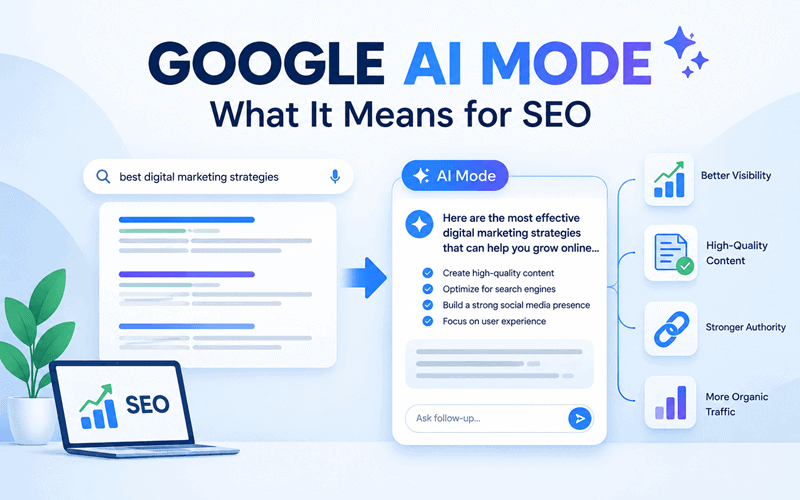
For website owners, bloggers, publishers and SEO professionals, this creates an important question: What does Google AI Mode mean for SEO?
In this guide, we explain what Google AI Mode is, how it works, how it differs from traditional Google Search and AI Overviews, and what website owners can do to improve their visibility in the changing search environment.
What Is Google AI Mode?
Google AI Mode is an AI-powered search experience that allows users to ask complex, conversational and follow-up questions directly within Google Search.
Traditional search often works best when a user enters a relatively specific keyword or short query. AI Mode is designed for questions that may involve multiple concepts, comparisons, follow-up questions or several steps.
For example, instead of searching separately for:
- Best SEO tools
- SEO tools for beginners
- Free SEO tools
- SEO keyword research tools
A user can ask a more detailed question such as:
“What are the best SEO tools for a small business with a limited budget, and which ones are useful for keyword research, technical SEO and competitor analysis?”
AI Mode is designed to understand the context of that question and provide a more comprehensive response.
How Does Google AI Mode Work?
Google AI Mode combines Google’s search technology with artificial intelligence and its broader information systems.
One important technology behind AI Mode is known as query fan-out.
What Is Query Fan-Out?
Instead of treating a complex question as a single search, Google can break it into multiple related searches or subtopics. These searches can be performed across different areas of the web to find information relevant to different aspects of the original question.
The information can then be combined into an AI-generated response.
This means that a single AI Mode question can involve several searches behind the scenes.
For SEO professionals, this is important because visibility may depend not only on ranking for one exact keyword but also on how well a website covers the different concepts and questions associated with a topic.
Google AI Mode vs Traditional Google Search
| Feature | Traditional Google Search | Google AI Mode |
|---|---|---|
| Query style | Often short and keyword-focused | Longer and conversational |
| Search intent | Usually focused on a specific query | Can handle multiple related questions |
| Follow-up questions | Usually require a new search | Designed for conversational follow-ups |
| Information gathering | Users generally review individual results | AI can synthesize information from multiple sources |
| Multimodal search | Available through various Google features | Designed to support text, voice and visual inputs |
| Search experience | Traditional results page | AI-powered conversational experience with web links |
Google AI Mode vs Google AI Overviews
Google AI Mode and AI Overviews are related but they are not exactly the same experience.
AI Overviews can provide an AI-generated summary within the search results for certain queries. Users can then continue exploring the topic or access links to relevant websites.
AI Mode provides a more conversational and exploratory search experience. Users can ask longer questions, ask follow-up questions and explore a topic through an ongoing interaction.
| Feature | AI Overviews | AI Mode |
|---|---|---|
| Primary purpose | Provide an AI-generated overview within Search | Enable deeper AI-powered exploration |
| Conversation | More limited | Designed for follow-up questions |
| Complex queries | Supports complex searches | Especially designed for detailed and multi-part questions |
| Query exploration | More focused on the original search | Supports continued exploration |
| Web discovery | Includes links to supporting sources | Includes links and opportunities to explore websites |
Why Is Google AI Mode Important for SEO?
AI Mode changes how people discover information.
Traditional SEO has generally focused on ranking pages for specific keywords and earning clicks from search results. AI-powered search introduces additional ways for users to discover information.
A website may now need to be useful for:
- Traditional organic search results
- AI-generated search experiences
- Long and conversational queries
- Follow-up questions
- Multimodal searches
- Specific subtopics within a broader subject
This does not mean traditional SEO is no longer important. Google continues to use its core search and ranking systems, and its guidance for AI search emphasizes established fundamentals such as helpful, unique content, good page experience and strong technical foundations.
Does Traditional SEO Still Matter With Google AI Mode?
Yes. AI Mode does not eliminate the need for SEO.
Technical SEO, crawlability, useful content, clear site structure, internal linking, page experience and relevant information remain important foundations for search visibility.
What is changing is the way users formulate searches and discover websites.
Instead of optimizing a page around one keyword and repeating that phrase throughout the article, websites should focus on completely answering the user’s underlying information need.
For example, a page targeting the topic “technical SEO audit” could naturally cover:
- What a technical SEO audit is
- Why technical SEO matters
- How to perform a technical SEO audit
- Technical SEO issues to check
- Website crawling problems
- Indexing problems
- Page speed and Core Web Vitals
- Mobile usability
- Internal linking
- Structured data
- Canonical URLs
- Redirects
- How to fix common technical SEO problems
This creates a more complete resource instead of a page written only around one keyword.
How to Optimize Your Website for Google AI Mode
There is no single guaranteed method for making a page appear in AI Mode. However, website owners can improve the overall quality, accessibility and usefulness of their content by following strong SEO practices.
1. Create Original and Helpful Content
One of the most important principles is to create content that genuinely helps users.
Avoid publishing articles that simply repeat information already available on hundreds of other websites.
Instead, add value through:
- Original explanations
- First-hand experience
- Examples
- Practical steps
- Original research
- Case studies
- Expert insights
- Useful comparisons
- Updated information
2. Answer the Main Question Early
Don’t make readers search through a long introduction before finding the answer.
Start each major section with a clear explanation and then provide additional details.
For example:
What is Google AI Mode?
Google AI Mode is an AI-powered search experience that allows users to ask complex and conversational questions and continue exploring topics through follow-up queries.
After giving the direct answer, you can explain how it works, why it matters and what users should know.
3. Cover Related Questions Naturally
AI-powered search can understand relationships between concepts. Therefore, comprehensive topical coverage can be more useful than creating dozens of thin pages targeting slightly different keywords.
If your primary topic is Google AI Mode, related sections could include:
- What is Google AI Mode?
- How does Google AI Mode work?
- What is query fan-out?
- Google AI Mode vs AI Overviews
- Does AI Mode replace Google Search?
- How does AI Mode affect SEO?
- How can websites improve visibility?
- What happens to organic traffic?
- How should SEO strategies change?
4. Use Clear Headings and Content Structure
Use a logical heading hierarchy to make your content easier to understand.
A strong structure can include:
- One clear H1
- Relevant H2 sections
- H3 sections for supporting questions
- Short paragraphs
- Bulleted lists where appropriate
- Tables for comparisons
- Examples and practical explanations
Clear structure helps users navigate long articles and makes important information easier to identify.
5. Write for Conversational Search
People increasingly ask complete questions instead of typing only a few keywords.
For example:
Traditional query: Google AI Mode SEO
Conversational query: How can I optimize my website for Google AI Mode?
Your content should naturally answer both types of search intent.
Do not force exact-match conversational keywords into every paragraph. Instead, understand the questions users are actually trying to answer.
6. Strengthen Your Topical Authority
Instead of publishing one article about AI search and stopping there, create a group of closely related articles.
For example, a website could create a Google AI Search content cluster containing:
- Google AI Mode Explained
- Google AI Overviews Explained
- Google AI Mode vs AI Overviews
- How Google AI Search Works
- How to Optimize for AI Search
- What Is GEO?
- GEO vs SEO
- How AI Search Affects Organic Traffic
- Zero-Click Search Explained
- Google Multimodal Search
These pages can be internally linked to create a strong topical relationship.
7. Improve Internal Linking
Internal links help users discover related content and help search engines understand relationships between pages.
For example, this article could link to related BrainIT articles about:
- SEO
- Google Search
- Google Search Console
- Keyword research
- Technical SEO
- Image search
- AI tools
Use descriptive anchor text that tells users what they can expect after clicking the link.
8. Keep Your Technical SEO Strong
AI-powered search does not remove the importance of technical SEO.
Make sure your website has:
- Crawlable pages
- Indexable important content
- Logical URL structures
- Mobile-friendly pages
- Fast-loading pages
- Good Core Web Vitals
- Proper canonicalization
- Correct redirects
- Useful internal links
- Accessible HTML content
9. Use High-Quality Images and Media
Search is becoming increasingly multimodal. Users can search using images, voice and other forms of input.
For content where visuals are useful, provide relevant and high-quality images with descriptive alt text.
For example, an article about Google AI Mode could include:
- AI Mode interface screenshots
- Search workflow illustrations
- Comparison tables
- SEO diagrams
- Original explanatory graphics
Images should support the content rather than being added simply to increase page length.
Does Google AI Mode Mean Keywords Are Dead?
No.
Keywords remain useful because they help identify what people are searching for and how a topic is described.
However, SEO should move beyond targeting a single phrase.
Instead of creating separate thin pages for every variation of a keyword, consider the complete topic and the different questions users may have.
For example, a website targeting Google AI Mode could naturally cover keywords and concepts such as:
- Google AI Mode
- AI Mode Google Search
- Google AI search
- Google AI Mode SEO
- how Google AI Mode works
- AI Mode vs AI Overviews
- Google AI search optimization
- AI search SEO
- AI search results
- Google generative AI search
The goal should be comprehensive coverage, not keyword stuffing.
What Is the Difference Between SEO and GEO?
SEO, or Search Engine Optimization, focuses on improving a website’s visibility in search engines.
GEO, commonly used to mean Generative Engine Optimization, is a newer term used to describe efforts to improve the likelihood that content is surfaced, referenced or represented in generative AI search experiences.
These concepts overlap significantly.
A strong GEO strategy should not be treated as a replacement for technical SEO or traditional content optimization.
Instead, website owners should continue building a strong SEO foundation while creating content that is useful, trustworthy, well-structured and easy for users and search systems to understand.
Can AI-Generated Content Rank in Google AI Mode?
Using AI to assist with content creation does not automatically determine whether content will perform well.
The more important question is whether the final content provides genuine value.
Automatically generated pages that provide little original value can create quality problems. On the other hand, AI can be used as a productivity tool when humans review, improve, fact-check and add meaningful expertise to the final content.
For SEO purposes, focus on the quality and usefulness of the finished page rather than simply whether AI was involved in its creation.
How Google AI Mode Could Affect Organic Traffic
The impact of AI search on traffic can vary by query, industry, website and search intent.
Some searches may be satisfied directly within Google’s AI experience, while other searches can lead users to websites when they want deeper information, original research, detailed guides, products or first-hand perspectives.
Google has stated that its AI search experiences are designed to help users discover websites and that its AI responses include links and attribution to web sources.
This means SEO should not be viewed only as a competition for a traditional blue-link ranking.
Website owners should also consider whether their content is useful enough to become a source that users want to explore further.
How to Prepare Your Website for the Future of AI Search
If organic traffic is your primary objective, focus on building a website that can answer a broad range of useful questions within your subject area.
A practical strategy includes:
- Identify topics with real search demand.
- Study the search intent behind each topic.
- Create comprehensive pillar content.
- Publish supporting articles around related questions.
- Connect articles using relevant internal links.
- Update older content when information changes.
- Improve technical SEO and page experience.
- Add original examples, research and insights.
- Use useful images and other relevant media.
- Monitor Search Console performance and update your strategy.
Google AI Mode and Long-Tail Keywords
Long-tail searches are particularly relevant to conversational AI search because users can describe their needs in much greater detail.
For example, someone interested in SEO might search:
“How can I improve the organic traffic of a small business website that has many blog posts but very few pages ranking on Google?”
This is significantly more detailed than a search for “SEO tips.”
Websites that publish useful content around detailed problems, questions and use cases can therefore create more opportunities to match specific search intent.
How to Create Content That Is Useful for AI Search
A strong article should make the answer easy to understand.
Consider using this structure:
Start With the Answer
Give a concise answer to the main question near the beginning.
Explain the Topic
Provide enough context for readers who are unfamiliar with the subject.
Break Down Complex Concepts
Use examples, lists and tables where they make the information easier to understand.
Add Original Value
Include your own examples, experience, research, observations or practical recommendations.
Answer Related Questions
Cover the important questions users are likely to ask next.
Keep Information Updated
AI search and Google’s search features are changing quickly. Review time-sensitive articles regularly and update outdated information.
Google AI Mode SEO Checklist
- Is the main question answered clearly?
- Does the page provide original value?
- Does the article satisfy the user’s search intent?
- Are related questions covered naturally?
- Is the content organized with clear headings?
- Are important sections easy to scan?
- Does the page have useful internal links?
- Is the website technically crawlable?
- Is the page mobile-friendly?
- Are images relevant and properly described?
- Does the content demonstrate experience or expertise where appropriate?
- Is outdated information removed or updated?
- Does the page avoid unnecessary keyword repetition?
- Does the content offer something beyond generic information available elsewhere?
Frequently Asked Questions About Google AI Mode
What is Google AI Mode?
Google AI Mode is an AI-powered search experience that allows users to ask complex and conversational questions, explore topics through follow-up queries and discover relevant information from across the web.
Is Google AI Mode the same as AI Overviews?
No. AI Overviews provide AI-generated information within Google Search for eligible queries, while AI Mode is designed as a deeper conversational search experience that supports longer questions and follow-up exploration.
Does Google AI Mode replace traditional SEO?
No. Traditional SEO remains an important foundation. Technical SEO, helpful content, crawlability, page experience, internal linking and relevant information continue to matter.
Can a small website appear in Google AI Mode?
There is no guaranteed method for appearing in AI Mode. Smaller websites should focus on producing genuinely useful, relevant and original content, maintaining strong technical SEO and building topical depth around subjects they cover.
Should I create separate pages for every long-tail keyword?
Not necessarily. If several keywords represent the same search intent, they may be better addressed with one comprehensive page. Separate pages are more appropriate when the search intent and information needs are meaningfully different.
Does keyword research still matter for AI search?
Yes. Keyword research remains useful for understanding demand, language, topics and search intent. However, modern SEO should focus on the complete information need rather than repeatedly targeting one exact keyword.
Is GEO replacing SEO?
No. GEO is a newer term associated with visibility in generative AI search experiences. Strong technical SEO and useful content remain important foundations for search visibility.
How can I optimize my website for Google AI Mode?
Focus on useful and original content, clear structure, strong topical coverage, relevant internal links, good technical SEO, useful images and a positive page experience. There is no guaranteed optimization technique that ensures inclusion in AI Mode.
Final Thoughts
Google AI Mode represents an important development in the way people search for and discover information online.
The biggest change for SEO is not simply the appearance of AI-generated answers. It is the shift toward longer, more conversational, multi-part and multimodal searches.
For website owners, the most sustainable approach is to build on strong SEO fundamentals while creating genuinely useful resources that answer real questions in depth.
Instead of creating content only to target a keyword, create content that solves a problem, explains a subject clearly and gives users a reason to continue exploring your website.
Google AI Mode may change how people search, but useful, trustworthy and accessible content remains at the center of successful search visibility.